
22 Jan 5 Proven Learning Hacks To Master The Periodic Table Today
When students encounter the periodic table formally in secondary chemistry, many feel intimidated. Rows of symbols, new names and formulas, all get messed up in the head. It seems that you have to learn the entire table by heart, but that’s a myth.
In reality, you have to understand how it is organised first. Secondly, you have to learn how to use it as a tool to make sense of element behaviour and reactions.
Our chemistry tutors at the Miracle Learning Centre always say this:
“The periodic table is not a list. It’s a map. It helps us analyse element behaviour to answer logical questions in exams.”
Do you know what that means?
Well, in simple words, the table is there to assist you and not complicate your learning. It’s a tool that helps you analyse complex reactions and map the results accurately.
Let’s now give you some amazing periodic table hacks that no school will teach you.
1. Avoid Treating It As a List
Many students try to learn the periodic table like they learn spellings. Repetition, rote memorisation, hoping that it will stick some day. But it doesn’t.
Because it’s not a list to learn by heart. It shows relationships, and every positioning tells a story that you need to understand. For example:
- Instead of learning what comes after Sodium, try to understand why Sodium occupies that particular place.
- Instead of memorising what elements are placed in a row, try to understand why they are placed like that.
Once you start identifying the organisation and hidden patterns, learning the periodic tables becomes easier and even fun.
2. Not A Chart, But A Map
What does a map tell you besides giving directions?
It helps you understand what surrounds you and gives a better idea about your position. The periodic table does the same.
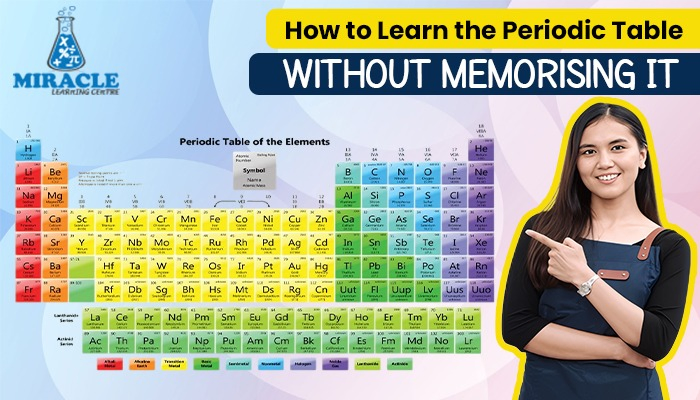
For example, rows tell you about energy levels of elements, while columns convey similar behaviour. Instead of memorising individual reactions, you can guess the same by just observing the positioning of different elements.
Do one thing. Pick any element on the table and look at its right, left, top and bottom. Now study these elements closely. You’ll definitely identify common patterns and behaviour, which will further help you solve equations.
We suggest you try this in your next chemistry tuition class. Our tutors will be glad to conduct this exercise as a fun experiment.
3. Try To Learn Elements In Groups
Memorising the properties and behaviour of each element separately can be mind boggling. And it’s not even needed. The periodic table is here to help you.
Understanding the outer particle arrangement in one element will give you an idea about the others in the same group.
For example, if you understand the reactive behaviour of alkali metals, you’re already aware of lithium, sodium, and potassium without learning them separately.
At Miracle Learning Centre, our chemistry tutors make it a practice to analyse the behaviour of one representative element in a group. They explain the outer particle arrangement, positioning and basic reactive behaviour of that element. In no time, the students can analyse the same for other elements in the same group without studying them separately.
4. Practise Memory Tricks To Recall Symbols Easily
Every chemical symbol feels like an alien name if you try to memorise it without understanding the element.
Change your approach immediately. Try to attach some kind of a visual image with the elements, like a swimming pool with Chlorine, a pencil lead with Carbon or electrical wires with Copper. When you do this for all elements, it becomes easier to recall symbols in exams.
Don’t go for scientific visualisations. These just need to be memorable and not purely scientific. Objects from day-to-day lives will do.
When you see the symbol the next time, the image comes to your mind, which then gives you the name of the element.
5. Use Relevant Questions To Learn The Table
Practise logical thinking along with learning. Only reciting the periodic table repeatedly won’t be of much help. Ask questions and find the answers. You’ll eventually get a grip of the entire table if you upgrade your thinking process through valid questions.
Instead of trying to analyse elements on the periodic table individually, try to come up with questions that the table helps you answer.
For example,
- Which is the most reactive element in the table and why?
- Which element would likely form similar compounds?
- Which group has the most unreactive elements?
These questions will help you train your reasoning power beyond simple recall. If you can make it into a regular practice, answering logical exam questions will become a cakewalk.
Consult The Best Chemistry Tuition Centre
Our JC chemistry tuition classes adopt a conceptual learning method to help secondary students with the period table. The best practices don’t involve learning about all the elements at once by understanding their behaviour through:
- Careful position analyses,
- Identifying common patterns, and
- Asking questions
This method helps in secondary chemistry as well as higher levels, when the periodic table is used to solve equations as well. Getting your foundations strong will make chemistry as easy as chalk and cheese when you are in the JC levels.
Talk to us anytime regarding specific queries or enroll in our classes directly to make the best of our study techniques. We are always here for you.