
14 Feb A Complete Guide To Vitamins As A Part Of Our Everyday Lives
When we hear the word ‘vitamins’, it doesn’t feel like some science topic at all. Let’s be honest, it sounds like some lifestyle advice.
“Eat that to get your regular supply of Vitamin C”
“This supplement holds more Vit B12 than that”
“Avoid that food. It has a lower concentration of vitamins and minerals.”
We already hear it every day, at home, from elders and well-wishers all around us. A regular intake of daily vitamins from food sources helps in the steady functioning of our organ systems.
But there’s no denying that studying vitamins is also an integral part of your science tuition classes. For example, we encounter vitamins while:
- Talking about nutrients moving across membranes,
- Explaining why certain substances dissolve in fat but not water,
- Understanding why enzymes refuse to work without helpers, and
- Realising the logical patterns in deficiency symptoms
Learning about vitamins can be quite exciting beyond textbooks. And that happens when you know these essential elements right from the beginning.
Two Distinct Behavioral Traits Of Vitamins
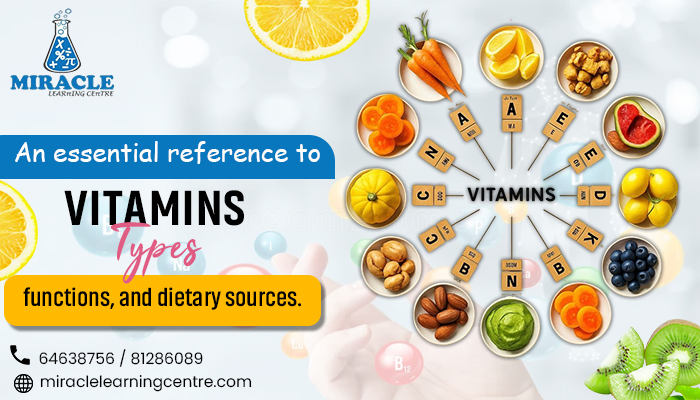
If you want to understand the types of vitamins, you have to start from their behavioural traits. All vitamins can be grouped into two categories based on their behaviour:
- Fat soluble
- Water soluble
This single quality can explain how different vitamins are absorbed, stored, and why some deficiencies appear readily while some take time.
Fat Soluble Vitamins
You can say that these vitamins are the long-term storage solution for our bodies. Fat-soluble vitamins dissolve in lipids and travel alongside fats during digestion. Because of this property, their absorption depends on bile, proper intestinal function, and the presence of dietary fat.
When these vitamins enter your body, they don’t leave fast. They remain.
1. Vitamin A
These vitamins are essentially important for vision, immunity and cell development. Tissues that require constant renewal perform well under the influence of these vitamins.
Foods like carrots, sweet potatoes, kale, mango, fish liver oil, fortified milk and butter are amazing sources of this vitamin. When supply drops, night vision weakens, infections become more frequent, and the skin becomes drier, and cracks tend to develop.
2. Vitamin D
A brilliant source of this vitamin is sunlight. Although some foods like salmon, sardines, mackerel, tuna, egg yolk, fortified plant milk (soy, almond), and cheese are good sources, exposure to sunlight is considered the best.
This vitamin is exceptionally good for calcium balance. It also fosters bone strength, muscle contraction, and long-term structural integrity. Deficiency symptoms don’t show up automatically but they appear ultimately in weaker bones. Most of the time, it shows up so late that the damage is already halfway.
3. Vitamin E
Inside the body, these vitamins quietly release oxidative stress from the cell membranes. Especially in the nervous tissue, where most fats are abundant, the vitamin E performs silently. You can consume this vitamin through almonds, hazelnuts, sunflower seeds, avocado, olive oil, corn oil, spinach, broccoli, and of course, your favorite, peanut butter.
What does its deficiency look like? Well, without enough of it, signals slow down, muscles weaken, and coordination suffers. These effects reflect cumulative cellular damage rather than any sudden failure.
4. Vitamin K
Our body contains proteins that help in clot formation as well as calcium regulation. Vitamin K helps promote the release of these proteins in our body. There’s an abundance of this vitamin in green vegetables, like kale, spinach, broccoli, swiss chard, cabbage, green peas, soybeans, and lettuce.
When there’s a deficiency, the body struggles to control bleeding, even when there’s no problem in the blood vessels.
Water Soluble Vitamins
These vitamins act faster than their fat-soluble counterparts. Dissolving easily with bodily fluids, these move seamlessly across the bloodstream. Also, as these vitamins cannot be stored in large quantities in the body, intake must be regular and consistent to prevent deficiencies.
This category is generally composed of two sub-categories:
- Vitamin C
- Vitamin B-Complexes
1. Vitamin C
This vitamin supports the formation of collagen, builds immune defence and antioxidants. You can obtain it from fruits and vegetables, like oranges, strawberries, kiwi, pineapple, lemon, bell peppers, broccoli, tomatoes, mango, and Brussels sprouts.
When intake is insufficient, connective tissues weaken first, leading to bleeding gums, slow wound healing, and increased susceptibility to infections.
2. Vitamin B-Complexes
The B-Complex Vitamins are a group of water-soluble vitamins that work together to
- Release energy (or fuel) from food,
- Support nerve communication,
- Maintain healthy blood cells, and
- Ensure proper growth and repair
Although these do not give you energy directly, they unifiedly act as essential helpers in certain metabolic and neurological processes. That’s the reason why deficiencies often affect energy levels, mood, nerves, and concentration first before affecting the body on a more physical level.
Let’s now explore the B-Complex Vitamins list with sources and deficiencies.
| Vitamin B Type | Common Name | Primary Role | Deficiency Symptoms | Main Sources |
|---|---|---|---|---|
| B1 | Thiamine | Releasing energy from carbs and supporting nerve signalling | Weakness and fatigue, problems in focussing and concentration, nerve issues. | Whole grains, brown bread, nuts, beans, lentils, sunflower seeds, pork, brown rice |
| B2 | Riboflavin | Tissue maintenance & Cellular respiration | Dry lips, mouth sores, inflammation on the skin | Dairy products, like milk, yogurt, cheese, protein-rich food, like eggs, fish, and also mushrooms and spinach. |
| B3 | Niacin | Balancing energy levels, DNA repair and nervous system stimulation | Digestive issues, mental fog, irritability on the skin | Protein-rich food, like chicken, tuna, turkey, salmon, peanuts, whole rains, etc. |
| B5 | Pantothenic Acid | Hormonal stimulation and stress regulation | Stress imbalances, tiredness, neurological discomfort | Avocado, broccoli, mushrooms, eggs, chicken, milk, whole grains, lentils |
| B6 | Pyridoxine | Protein metabolism and neurotransmitter production | Mood swings, immunity issues and weak nervous regulation | Potatoes, sweet potatoes, bananas, spinach, nuts, fish and chicken |
| B7 | Biotin | Fatty acid metabolism and tissue maintenance | Skin and hair problems, neurological imbalances | Egg yolk, almonds, walnuts, sunflower seeds, avocado, soybeans, milk |
| B9 | Folate | RBC formation and DNA accuracy | Low oxygen transport to cells and anaemic conditions | Spinach, kale, lentils, chickpeas, broccoli, citrus fruits, fortified grains, avocado |
| B12 | Cobalamin | Production of RBCs (red blood cells), nerve insulation | Memory issues, nerve damages, anaemia | Red meat, chicken, fish, shellfish, milk, yogurt, cheese, eggs, etc. |
Vitamins As Applied Science
In our Secondary science tuition classes in Singapore, we teach students about vitamins by referring to their importance in day-to-day lives. In other words, it’s taught as applied science and not a separate topic.
For example:
Solubility of the vitamins determines absorption rate, which in turn, determines transport of vitamins in the body. Now, transport is linked to storage and when that part is clear, deficiency symptoms get easier to memorise.
When we are done, students have better clarity on vitamins than solely any textbook could have ever given them.
Conceptual Learning Strengthens Subject Foundation
It’s not that we teach only the types of vitamins this way. We follow this application principle in every science topic that’s in the MOE syllabus.
At Miracle Learning Centre, enjoying the learning process sits at the core of our teaching methods. If you have enjoyed this article about vitamins, know that it’s just a glimpse of what awaits you at our primary science tuition classes. You’ll know only when you ATTEND them.
So, what are you waiting for? Get enrolled today and experience science like never before!