


09 Feb From Atoms to Amounts: Why the Mole Concept Is the Backbone of Chemistry
Chemistry is often described as the science of matter but at its core, it is really the science of amounts. Atoms and molecules are unimaginably small, yet every chemical reaction we observe depends on how many of these tiny particles are involved. This is where the Mole Concept becomes the backbone of chemistry, bridging the atomic scale with the measurable quantities we use in laboratories, classrooms, and everyday life.
For students studying chemistry, especially at the secondary and senior secondary levels, mastering the Mole Concept is not optional, it is essential. Whether you are calculating reactants, predicting products, or solving numerical problems, the mole acts as chemistry’s universal counting unit.
Understanding the Mole Concept
Atoms and molecules are too small to count individually. Imagine trying to count grains of sand on a beach, now imagine counting atoms in a drop of water. To solve this problem, chemists use the mole, a standard unit that represents a fixed number of particles.
One mole of any substance contains Avogadro’s number, which is:
6.022 × 10²³ particles
These particles can be atoms and molecules, ions, or formula units. Just as a dozen always means 12 items, a mole always means 6.022 × 10²³ particles no matter what substance you are dealing with.
This simple idea allows chemists to connect:
- The mass of a substance (what we can measure)
- The number of particles (what actually reacts)
Why the Mole Concept Is So Important
The Mole Concept is the foundation of chemical calculations. Without it, chemistry would be reduced to guesswork. With it, chemistry becomes precise and predictable.
Here’s why it matters:
1. Connecting Mass to Particles
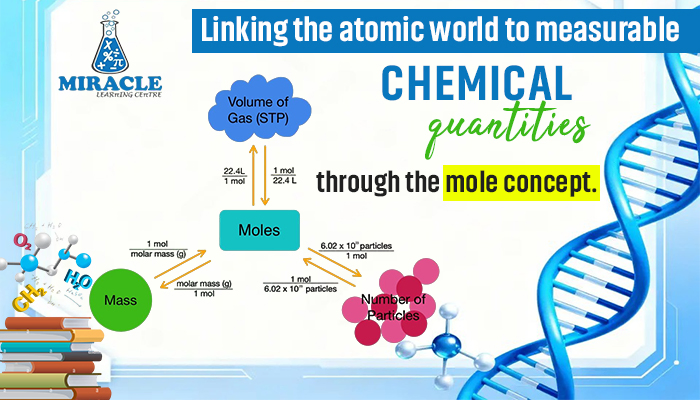
Chemical reactions occur between particles, not grams. The mole allows us to convert mass into the number of atoms or molecules involved in a reaction.
2. Balancing Chemical Equations
Balanced equations are written in terms of moles, not masses. The coefficients in equations tell us the mole ratio in which substances react.
3. Stoichiometry Made Possible
Stoichiometry, the calculation of reactants and products depends entirely on mole relationships.
4. Real-World Applications
From pharmaceuticals to fertilizers, from fuels to food chemistry, industries rely on mole-based calculations to ensure accuracy and safety.
From Atomic Scale to Real Measurements
The atomic scale is far beyond human perception. A single atom has a mass of around 10⁻²³ grams. The mole acts as a translator between this microscopic world and the macroscopic world we live in.
For example:
- 1 mole of carbon atoms weighs 12 grams
- 1 mole of water molecules weighs 18 grams
This relationship between molar mass and the mole allows students to confidently move between atoms, molecules, and grams.
What Students Should Remember About the Mole Concept
When studying the Mole Concept, students should focus on these key ideas:
- A mole is a counting unit, not a mass or volume
- Avogadro’s number is fixed and universal
- Molar mass (in g/mol) numerically equals atomic or molecular mass
- Mole ratios come directly from balanced chemical equations
- Conversions between mass, moles, and particles are central to problem-solving
Understanding these principles deeply makes advanced topics like gases, solutions, and thermochemistry much easier.
What Students Should Not Do
Many students struggle with the Mole Concept because of common mistakes. Avoid these pitfalls:
- Memorizing formulas without understanding their meaning
- Mixing up mass (grams) with amount (moles)
- Ignoring units during calculations
- Skipping steps in conversions, leading to careless errors
Chemistry rewards clarity and structure, rushing through mole problems almost always leads to confusion.
How Proper Guidance Makes a Difference
The Mole Concept is often the first topic where students feel chemistry becoming “numerical” and intimidating. With the right explanation and guided practice, however, it becomes one of the most logical and rewarding topics in the subject.
This is where structured Chemistry Tuition plays a crucial role. At Miracle Learning Centre, students are taught the Mole Concept step by step, starting from basic particle ideas and gradually moving to complex chemical calculations. The focus is not just on solving problems, but on building confidence and conceptual clarity.
Our Chemistry tuition in Bukit Timah teaches with experienced educators, exam-oriented practice, and personalized attention. Students learn why formulas work, not just how to use them.
Final Thoughts
From atoms you cannot see to amounts you can measure, the Mole Concept is chemistry’s most powerful bridge. Once students truly understand it, chemistry stops being a collection of formulas and starts making sense as a logical, interconnected science.
If you want your child to develop a strong foundation in chemistry and master essential topics like the Mole Concept with confidence, Miracle Learning Centre offers the guidance, clarity, and support needed to succeed both in exams and beyond.