


14 Jan Understanding The pH Scale Beyond Rote Memorisation Or Just Numbers
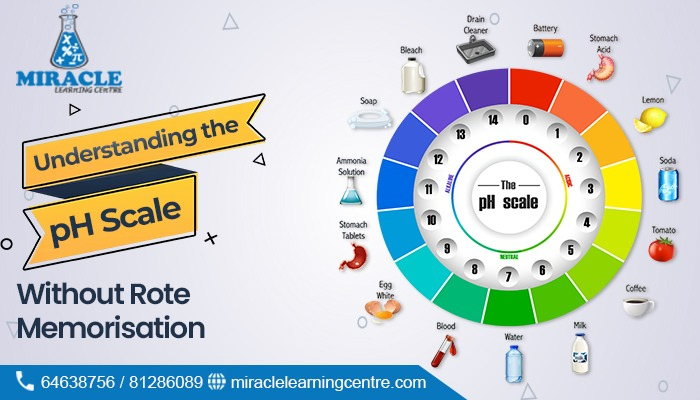
The neutralisation mark on any pH scale is 7. And every secondary chemistry student knows it. Alkalis or bases come above 7, while acids fall below it.
But this is the basics only. The pH numbers attributed to individual elements constitute the intensity of their acidic or alkaline nature. For example,
- HCL (acid) is pH 1
- Sodium Hydroxide (base) is pH 14
- Vinegar or Acetic acid is around pH 3
- Soap (alkali) falls in the range of pH 9-10
Understanding the pH scale, however, goes way beyond these numbers. Students try to memorise the pH values without understanding the reasons behind them.
When exam papers ask for further explanations, they tend to panic, unable to write the answers properly.
A simple truth is - The closer the numbers to 7 on the pH scale, the weaker is the acidic or alkaline quality of any given substance.
In our O Level chemistry tuition classes, the tutors always explain the reasons first, so you get enough clarity to answer tricky questions. When you understand how the scale behaves, exam questions become a cakewalk.
Why Some Students Find pH Scale Difficult?
Did you find anything written in this post difficult so far? No, right?
Then why do many secondary students find the acid and base chapter or the pH scale harder to understand?
When we asked Mrs Lew, a knowledgeable and experienced chemistry tutor at our centre, she shared something interesting.
This is what she said,
“In most schools the pH scale is not introduced independently. It’s accompanied by hydrogen ions, hydroxide ions, indicators, neutralisation and more. Students feel overburdened and somewhat overwhelmed. If these elements are presented one by one, they can grasp the concepts easily. Further, questions like why smaller numbers mean stronger acidity or why the scale goes from 0 to 14, also come to their minds, which they brush off as irrelevant. But we know these are valid questions that they feel somewhat shy to ask.”
The O Level exams don’t test your memory but your ability to understand concepts. And that’s what the best chemistry tuition centre aspires to achieve for every student.
How The pH Scale Actually Measures Acidity Or Alkalinity?
In simple understanding, the pH scale measures the acidity or alkalinity of a substance. But in reality it measures the amount of hydrogen ions.
When dissolved in water,
- Acids produce more concentration of hydrogen ions
- Alkalis give less concentration of hydroxide ions
- Neutral elements, like water, have a good balance of both
The pH scale measures this concentration to constitute the acidity or alkalinity of the element.
When the pH is neutral, it doesn’t mean that the subject doesn’t have either hydrogen or hydroxide ions. It means that there is a good balance of both, thus neutralising the effect.
How To Understand Acids And Alkalis Without Numbers?
Most students tend to memorise the pH values of different substances to perform well in the exams. But there are endless acidic and alkaline elements on the planet.
How many will you learn? And even if you do, it’s not feasible to remember all of them. A smarter way will be to remember the direction -
- pH below 7 is acidic
- pH above 7 is alkaline
So the smaller is the value of an acid, the stronger it is in concentrated form. However, the larger the value of a base, the stronger is its alkalinity.
You should also remember that the pH scale is not linear. The change of a single value on it, be it acidity or alkalinity, is a tenfold change in real life. It means that pH 1 acid is ten times stronger than a pH 2 one, and a pH 9 base is 100 times stronger than one with pH 7.
Although secondary chemistry doesn’t expect you to directly calculate the values or strengths of elements through the pH scale, having clarity is essential for your exams.
The Role Of Indicators In Measuring pH
Indicators, like the litmus paper, don’t exactly give you answers on the acidity or alkalinity of an element. It’s just a tool to indicate IF the subject is alkaline or acidic. The pH meter, on the other hand, can give you an approximate numerical value. But it makes sense only if you understand those numbers, that is if your concept regarding the pH scale is clear.
The different types of indicators include:
- Litmus Paper - One of the simplest indicators, it helps identify acids or alkalis with color indication. Red litmus turns blue in an alkaline solution, while blue turns red in an acidic one.
- Universal Indicators - It uses different shades to give an approximate idea about the strength of a given acid or alkali.
- pH Paper - It also acts as the universal indicator, producing different colors when dipped in an acidic or alkaline solution. Using a reference chart, you can get an approximate numerical value.
- pH Meter - This is an electronic instrument that gives the exact pH value of an acid or alkali. It even extends the value to one or two decimal places to provide maximum accuracy.
- Natural Indicators - Some naturally-occurring elements, like red cabbage juice, turmeric, and hibiscus extract, also change color when in contact with acidic or alkaline solutions. These are called natural indicators of acidity or alkalinity.
Important note for exams - One thing that every student should remember is, the indicators
Misconceptions About Acids And Bases Explained
Before you sit for your O Level chemistry exams, it’s essential that you have all your misconceptions about acids and bases cleared.
At Miracle Learning Centre, our chemistry tutors sometimes hold fun and interactive myth debunking sessions after completing each chapter. Students love this, as they both get to clarify their misconceptions as well as learn chemistry in a fun way.
Some of these conceptual errors include:
1. Neutral substances are harmless
It just means that the element has a pH of 7, indicating almost equal concentrations of hydrogen and hydrogen peroxide ions. But the substance can be corrosive when consumed beyond a certain amount. For example, consuming too much distilled water can disrupt the body’s electrolyte balance. A neutral sodium chloride solution also has a pH of 7 but can be harmful for the body if consumed in large quantities.
2. Strength is equal to concentration
Many students at our secondary chemistry tuition often exhibit unclear conceptions, like the more concentrated the acid or base is, the stronger it is. But this is far from reality. Concentration and strength are two different qualities of an acidic or alkaline solution.
Strength is a measure of how completely the substance ionises in water, while concentration is the amount of acid or alkali dissolved per unit volume.
What does that mean? Well, it clearly means that a strong acid can be more dilute than a weak one.
3. Stating how the pH changes is enough to get full marks
This misconception exists among many students. They think that mentioning how the pH changes when in contact with an acid or base is enough for the exams. But it’s not. You also need to explain the direction to which it changes, like if it increases or decreases and what exactly does that mean for the substance. You should also remember that the indicators don’t have any effect on the acidity or alkalinity. It states the quality but doesn’t change it.
Common Types Of Questions In Exams
In your O level exams, you’ll not get questions like,
- Name three acids and three bases,
- Define the pH scale, or
- State the pH of vinegar, soap and H2SO4
You’ll get questions that test your understanding of the pH scale and not the power of your memory. For example:
- X solution has a pH of 2, while Y solution has a pH of 4. Compare the levels of their acidity or alkalinity.
- An acidic solution is poured into an alkaline solution gradually. State how the pH changes and why.
- The universal indicator turns green after a reaction. Explain what you understand from this observation.
How To Score High Grades In O Level Chemistry
We can give you some tips like:
- ALWAYS state if the pH increases or decreases on the scale. Simply stating that it changes isn’t enough.
- Connect your answer to the concepts of acids, bases and neutralisation. State what solution is being added to which one and how the former changes. Also mention which indicator is being used.
- Always explain the ‘whys’ in addition to the ‘whats’. Write each sentence clearly and explain the procedure with clarity. Think of the examiner as your student, who needs to understand the reaction properly by reading your answer.
Final Thoughts
We hope that you have a clearer idea of acids, bases and neutralisation now. At Miracle Learning Centre, we use such step-by-step learning methodologies to clear concepts and help students achieve higher grades. We help them learn at their own pace, without falling back. Our personalised learning approaches ensure you think like a scientist, work like a researcher and solve problems like an engineer.
So before you type, “tutor for chemistry near me” in the search tab, do give us a call. We’ll listen to your specific learning requirements and explain how we can help fulfil the same. There’s a reason why we’re considered as one of the best chemistry tuition centres in Bukit Timah, Singapore. Talk to us once and you’ll know.